Tuesday, August 16, 2011

Chimney Swifts over the West River

It's close to impossible to get a close-up view of a Chimney Swift. They are spending most of their lives on the wing, feeding, drinking, even copulating in midair. They roost in chimneys, or other man-built structures, using their clawed feet to cling to the walls while bracing themselves with their spiny tails. With the change in the urban landscape and loss of suitable roosting places their numbers are diminishing. 


On a recent late afternoon I saw a loose, widely spaced group of Chimney Swifts, numbering perhaps thirty (see comment below), hawking for insects over the West River and surrounding fields. They were swooping and twisting overhead, cutting through the air, then rising suddenly on fluttering wings high into the sky and seeming to disappear over the trees and hills, only to reappear just as suddenly. They were changing so rapidly that I trouble focusing the camera on any particular bird. At home I had to do a lot of post-processing of the RAW images to give the birds shape and volume rather than showing them just as black silhouettes.

While soaring the bird often fans its tail

Here you get a suggestion of spikes in the tail.


A couple of months ago, standing on my deck, I was surprised by a loudly chirping trio swooping and circling and making sharp turns overhead. It only lasted for a couple of exhilarating minutes and then they were gone. Later I found out that this was probably part of a courtship display with two males chasing and courting one female.

James Audubon's wonderful painting of the Chimney Swift illustrates their hawking flight with gape wide open to catch insects. It also shows the claw-like feet, and lastly how a nest is constructed and glued to the wall with saliva, similar to the nest of a Cliff Swallow, - although swifts, contrary to expectation, are actually related to hummingbirds.


To really appreciate the beauty of this painting click to enlarge these images.

Cheers and Good Birding!


Comment on estimating numbers: It seems we are born with an innate sense of numbers: 

A study -- published online in a recent issue of Developmental Science -- indicates that math ability in preschool children is strongly linked to their inborn and primitive "number sense," called an "Approximate Number System" or ANS.
The article contains a link where you can test your own sense of numbers.


Thanks for stopping by. Please leave a comment.


Wednesday, August 10, 2011

Strange Tale of Dog and Deer


This is a true story:
A couple of days ago I was walking along a logging trail on a nearby mountain with my dog Chance. After a sweaty and buggy uphill climb we finally reached the top, a large clearing overgrown with weeds, brambles and small trees. As I was scanning the leaves for small disturbances indicating a bird, Chance took off into the woods. After a few minutes I heard a distant yelp. Fear or pain? I called him back with no response. I heard nothing further. While waiting for him to return I noticed two small birds in the undergrowth nearby, two foraging Ovenbirds who paid little attention to me.


Suddenly, to my relief, I saw Chance trotting through the thinning forest about 50 yards off on my right. With his white coat and large black patches he was easy to spot. As he approached the clearing I expected him to turn toward me, but instead he continued straight on.

I should say a few words about Chance: He is friendly to all creatures except small furry things. Having been bitten as a puppy by an older dog, he is timid with other dogs and, if we encounter any on our walks, he clamps his tail between his legs until they have proven to be friendly. He has not met up with larger animals such as cows or horses. He has never seen deer at close range, only at a distance running across the field next to our house.
What happened next keeps replaying in my mind as if on a stage: a few steps behind him an adult antlerless deer was keeping pace with him. Chance continued to make his slow way through the weeds and low brush, stopping  at times to sniff  or examine something. The deer too stopped moving and resumed his pursuit as Chance moved on. Chance, seemingly unaware to his strange escort, did not once turn around. Soon both disappeared into the woods at the opposite edge of the clearing.

A couple of minutes later I saw the deer again, standing, as if posing, straight ahead at the edge of the plateau framed by two trees with  the sky as a backdrop. After a minute or so the deer walked off, stage left, and Chance reappeared from the woods on my right. Did he circle around behind me?

I had had a clear view of the entire strange spectacle but was so mesmerized by it that it never occurred to me to lift up my camera and and take a picture. So nothing to document it. I am still totally perplexed, still can't make any sense of it. 

A unedited preview of the peacable kingdom?


Jan Bruegel "Paradise" ca. 1620

Thanks for stopping by. Please leave a comment.


Tuesday, August 2, 2011

Walking on Water

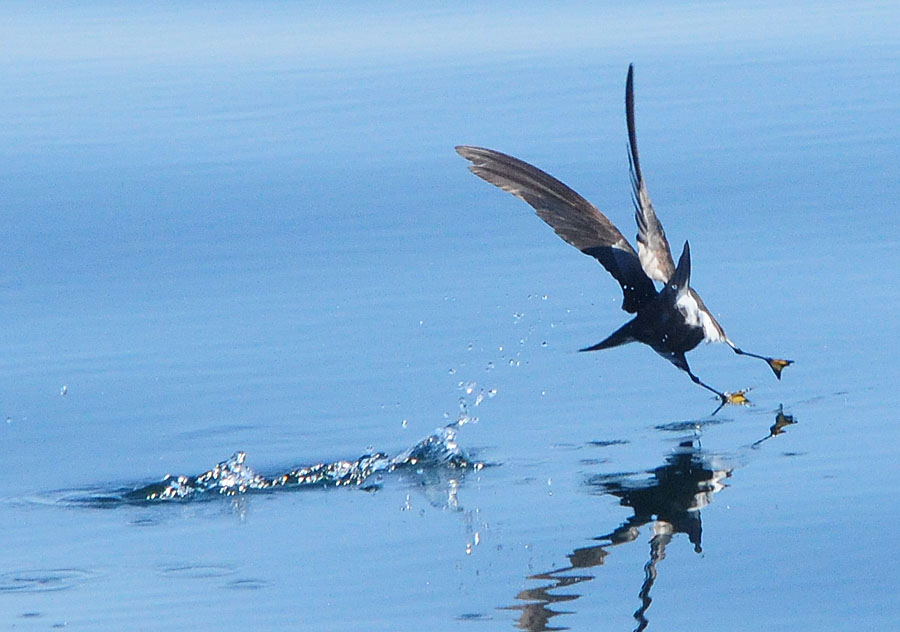
The Wilson's Storm-petrel is one of the most abundant birds on earth, but is rarely seen since it spends all its life on the ocean, coming to shore along the Antarctic coast only to breed. To escape the Antarctic winter it migrates to the northern hemisphere, summering on the North Atlantic, less commonly the Pacific.

On a pelagic trip off the coast of Massachusetts we saw them in large floating rafts which would disperse rapidly upon our approach.  Pattering with raised wings over the ocean surface foraging on plankton the birds looks like they are dancing.


When growing up I always dreamed of living close to the sea, of looking into the distance where water meets sky, and imagine far-away lands beckoning with strange lives and magical adventures. Well, here I am in land-locked Vermont...  I still love to visit the coast, walk along the beach, looking out over the ocean swell, watching the waves come in and dissipate in the sand.


I love the sounds the waves make.

When the noise around me gets too much I listen to a recording of ocean swells inside a rocky cave. Here is a snippet of End of the Cavern. The mp3 file is available here.


Thank you for visiting. Please leave a comment.