Tuesday, December 7, 2010

"Manky Mallard " on World Bird Wednesday

A couple of days ago I was driving past an old isolated beaver pond  when I saw what looked like a lone pale pinkish duck on the water. On its head sat a fluffy kind of pom-pom. A new species of duck? A vagrant? A reportable rarity? For a few moments visions of glory floated through my head, the kind of glory that only a birder would comprehend.

I rolled down the window and tried to get a picture but the duck had quickly moved out my field of vision. So I slowly got out of car in order not to alarm it. No to worry however, as soon as I stood up the duck paddled toward me and to my great surprise scrambled up the embankment onto the dirt road.  He quacked a couple of times and stretched his neck toward me, as if expecting a hand-out. Yet as I approached him he flew back into the water.

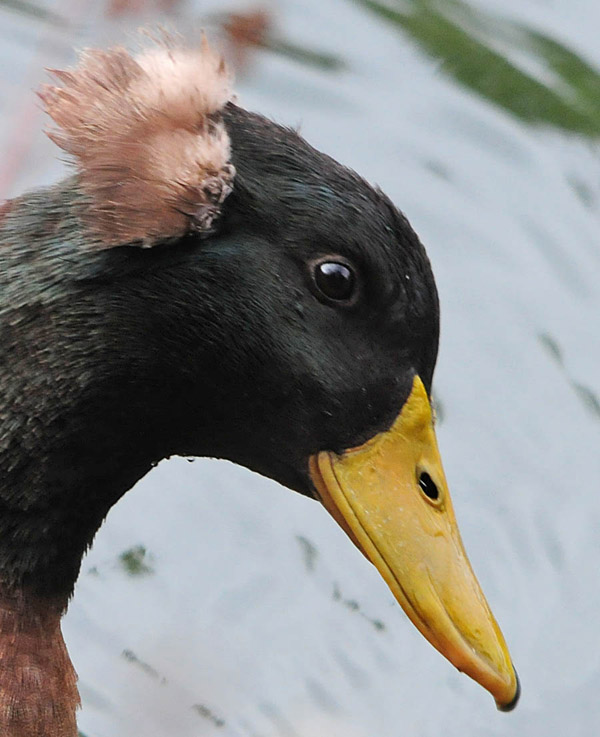
I am saying "he" because, despite his apricot pink color and poodle-like top knot, he looked like a male mallard. The bill was the same yellow color, the neck and head an iridescent green and his tail coverts curled up just as in a male mallard.


Here is a close-up


It was pretty obvious to me that he was an escapee, but from where? Nobody in the immediate area that I know of had ducks as pets. Was it a leucistic variant perhaps or an hybrid or a special domestic breed?

I did some research and came up with an article by Charlie in the 10,000 Birds, titled "Manky Mallards" (domestic, feral or just plan odd  mallards) It contains many photos of these odd looking ducks which are not hybrids but 100% mallards, the result of selective breeding.

The "crest" gene is a dominant mutation that can be bred into most any duck. It's associated with a deformityy of the skull. The gene is also causing partial infertility.

Quoting  from another website on the history: Crested ducks have a wonderful regal air about them. There are reasonably good layers but mostly kept for pets. Crested ducks have been around for a long time and feature in art dating back over 2,000 years.

Well, this morning I checked the pond: The water had frozen over and I was glad to see that the duck did not sit locked in the ice but had been smart enough to take to the air.

Participate in World Bird Wednesday!


Thank you for stopping by. Please leave a comment. 

Enhanced by Zemanta

Saturday, December 4, 2010

Where are the Birds? with correction


December.  I am desperate for birds. The woods have been quiet and skies empty. I'll soon be going into serious withdrawal. So I drove to Turner's Falls, MA,  to check out the power canal as James Smith of  Pioneer Birding had reported sightings of Cackling Geese and Iceland Gulls.

It was mid afternoon, the sun much lower in the sky than I had foreseen. Several groups of Common Goldeneyes were on the water and I got some photos before they had a chance to turn tails and swim toward the opposite shore as is they are prone to do when seeing anyone approaching them.


Male Common Goldeneye

Male flying


Flock of three females and one male


On the water there were several hundred Canada Geese, but I was lucky: Shortly after my arrival when passing the first group of Canada Geese  I saw a bird near the periphery which was strikingly smaller than the others. I was able to get a shot but the waning light resulted in a picture of poor quality. The petite size and build convinced me that this was a Cackling Goose but I stand corrected:

Thomas Wetmore pointed out that the photo probably shows an Atlantic subspecies of a Canada Goose, not a Cackling Goose. Cackling Geese are small still, show a stubby bill, short neck and blocky head with large cheek patch.


Far off shore were several gulls, mostly Herring Gulls, several Great Black-backed Gulls and a couple of lst cycle Iceland Gulls.


This photo shows an Iceland Gull standing on ice surrounded by Herring Gulls and GBBB juveniles which I took at Turner's Fall this past February. (More photos on my website, bottom of page.)


I am going to give it another shot next week. Timing is always finding the right balance: too early and the light is good, but the birds have not yet flown in to roost; too late and there is too little light.


November morning, Connecticut River, Hinsdale, NH


Thanks for stopping by. Please leave a comment.

Wednesday, December 1, 2010

Wordless Wednesday


Horned Grebe

Thanks for stopping by. Please leave a comment.