Tuesday, March 15, 2011

Looking back: Pine Grosbeaks

Pretty soon migrating ducks will appear in the local puddles and on flooded fields, snipe will forage in the weeds along the edges, and killdeer will emit their sharp cries when flushed from a field. At dusk I'll hear the peenting of a courting woodcock at the edge of the forest. But right now it's the in-between time, mud time. 

You can always count though on Black-capped Chickadees.


You can always count though on Black-capped Chickadees.


Now is a good time to dig out photos of a birds that did not show up this winter, did not irrupt into New England, presumably because there was plenty of food for them up north: the Pine Grosbeak. I saw a small flock of them foraging in fruit trees two winters ago. They are slow moving and easy to overlook.


A female "Rusty" so called because she is sporting a rusty patch on her chest.


Male Pine Grosbeak


Female "Rusty"

I am confident I am going to have photos of some spring-time birds next week - at least of Red-winged Blackbirds. They have already made their presence known with their gurgling "tur-a-lees" sounding from several shrubs in our wetland.

Thanks for stopping by. Please leave a comment.


Tuesday, March 8, 2011

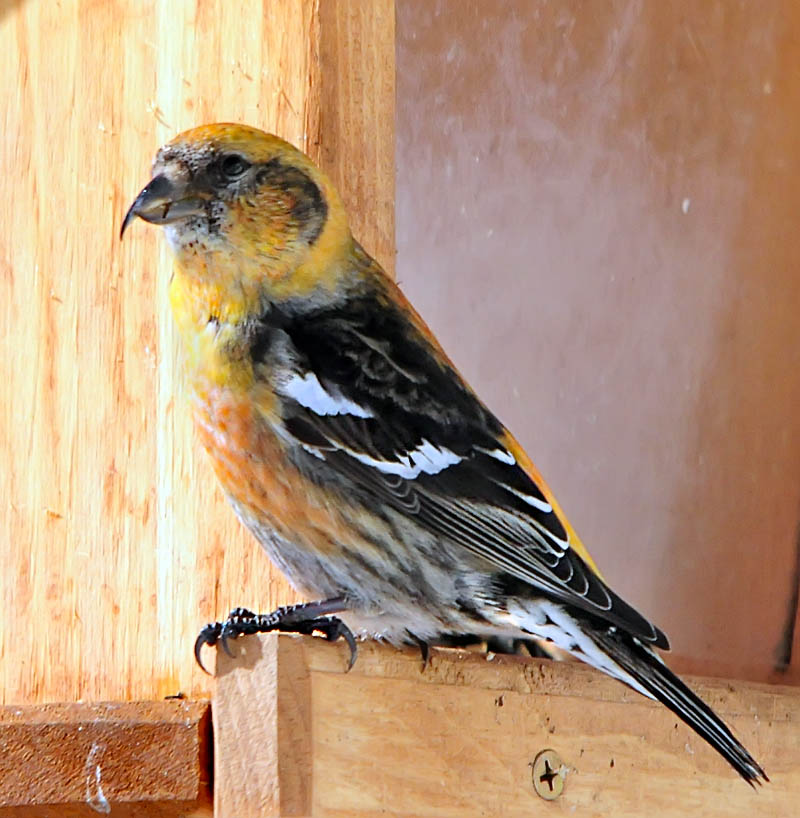
Winter Visitor: White-winged Crossbill

White-winged Crossbills are at home in the northern boreal coniferous forest where they feed on conifer seeds. With their crossed bills they are wedging the scales of the conifer cones open, and lift the seeds out with their tongue. They are nomads traveling where ever conifer seed is in abundance, and in the winter they often appear in the northeast. A male has been reported at a feeder on the campus of Putney School for a couple of weeks but I had had no luck  seeing the bird until today. 

It was a brilliant morning. When I arrived on campus the trees were glittering, each twig studded with sparkling ice crystals. The White-winged Crossbill, an immature male, was hunkered down on a feeder by the campus kitchen busy with picking sun-flower seeds.

.


He started out in the shade, but gradually made his way into the sun. He also stopped feeding having apparently gotten his fill.


He had started off feeding in the shade, but was gradually working his way into the sun.


I am not sure what he was looking at under the roof but shortly after he flew off.

So I  was able to add another bird to my life list, bringing the count up to 271. I'd like to thank Ken Klapper, expert birder from Keene, in locating these birds and pointing them out to me.


Thanks for stopping by. Please leave a comment.

Tuesday, March 1, 2011

Carolina Wren, Bohemian Waxwing, and a personal update

Last Saturday I drove to Putney School to look for the pair of White-winged Crossbills that had been reported there along with a flock of Bohemians. The Crossbills didn't show up at the feeder where they had been seen before, but a Carolina Wren was perching on top of a shrub nearby singing loudly. Of course as soon as I grabbed my camera it took off for a tree at some distance. Still I managed to get a couple of photos.


Their song  consists of a rich variety of phrases, uttered with a vocal force that's amazing in such a small bird.. 

I also observed a mixed flock of about 20 Cedar and Bohemian Waxwings in a crab apple tree, but the snow that had fallen the previous night made it difficult to get close. So I only got one fairly decent photo.


Now for a change of subject: 

I have been meaning to post an update on my brother whose bicycle accident last July resulted in massive head trauma  affecting mostly the speech center on the left side. After months of rehab he is home now, but things are far from ordinary. The accident resulted in him losing his speech. He understands questions but is unable to answer. He can't find the proper words - they come our garbled - nor can he string them together into a meaningful sentence.

I have been trying to imagine what that feels like. How do you fill the emptiness when that inner speech, that running commentary on your life is silenced? Speech is integral to thought and has been an integral part of our genes for about 40,000 years. On the outside he looks just the same as always, but losing that you lose a major chunk of who you are. I have difficulty wrapping my head around that fact.

He is receiving speech therapy of course and our hope is that other nerve cells will take over the function of those that are lost, hope that his brain is young enough to make that switch. Only time will tell.


Thanks for stopping by. Please leave a comment.


Enhanced by Zemanta