Showing posts with label Bald Eagle. Show all posts

Wednesday, September 12, 2012

Common Nighthawk Migration


For the past couple of weeks I have given supper short shrift  -  quick meals out of the freezer or whatever leftovers I could put together -  because during the second half of August supper time is when the Common Nighthawks pass through on their fall migration. Every evening for the past several years Vermont birder Don Clark of Grafton has has been observing the migration at Westminster Station near the Connecticut River, a perfect wide open location with good views in all directions.

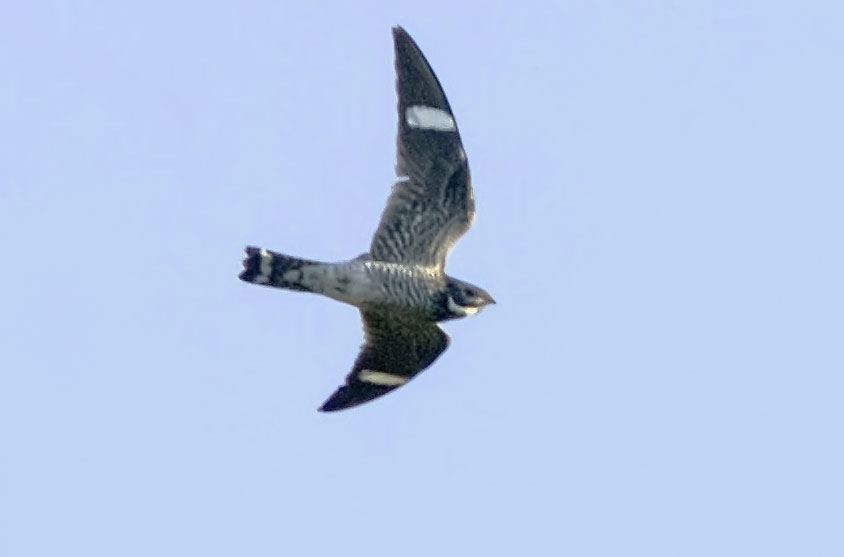
Other birders, both local and from across the state, have been joining  him in spotting and counting the passing migrants for the annual record. They fly in small flocks, starting as barely visible dots on the distant sky, then turning into tiny ciphers fading in and out of view, and then suddenly they are right overhead, flashing their white wing patches, with little time for the lens to lock onto the target. When actively feeding their flight is erratic, banking and curving, suddenly veering off into a different direction. And before you know it  the opportunity to catch a good shot has passed. I found it helps to set my camera on continuous autofocus, have a fast memory card and then fire away until the buffer is full at about 100 shots, if set on JPEG Fine, or 19 when shooting RAW.

Male Nighthawks are distinguished by a white sub-terminal tail band which is absent in females and juveniles. 


I am including these two shots, the one above and one below, because the legs are extended. They weren't coming down to land, but maybe they did so for some other maneuver that escaped me. 


The birds are often flying with their huge mouth agape when hawking flying insects, but  I only caught two of them doing so.


I apologize for these blurry shots, just using them to illustrate this behavior.


Common Nighthawks are long distance migrants from continental North America, usually along river valleys and lake shores, to their wintering quarters in South America. They have been listed as critically imperiled in the New England states.  In the past, migratory flocks often numbered in the 1000's  According to Don Clark the highest number this year at Westminster Station was 641 on 8/22, but on most evenings the counts were much lower, often in the 100's or low 200's. 


Here's a link to a  video featuring  recordings - the peenting nasal call and the boom made by the wings when the bird is diving - narrated by Macaulay Library curator Greg Budney. Great photos too, much better than mine.

Finally on the last day, just when the numbers of passing Nighthawks had tapered to almost nothing, we were treated to two Bald Eagles circling above.


Happy Fall Birding!


Thursday, November 4, 2010

The Sadness of Captive Birds

A couple of days ago I revisited the VINS rescue and rehab organization in Quechee, VT.  It was a cold blustery day. Walking along the roofed over semicircle from cage to cage with eyes following me, I found not much had changed from three years ago. The two Bald Eagles, disabled by injuries, who arrived in 2000 and 2002, were still there.


 Back then a couple of volunteers were crawling around on the ground cleaning the cage to the great annoyance and vocal complaints of one of the eagles.


Sounds like an upset chicken, right? Eagles are so imposing that  they probably had no need to evolve a voice to go with it, I guess. Maybe they just needed enough voice to comfort their offspring.

Also still here:
Golden Eagle (since sometime in the 90's)

Peregrine Falcon (since 1995)

Broad-winged Hawk (since 2007)

Snowy Owl (since 2006 - raised in captivity)

Common Raven
Common Raven couple preening (the male since 1997 and the female since 2001)
Common Ravens are smart, they are curious, they investigate their environment. But what if there is nothing to investigate? Nothing to stimulate their minds, just a bare cage with wooden perches? Their cage was, I guess, adequate in size, but how humane is it to keep birds, who cannot be released back into the wild,  in barred cages, as if they were automata, for years if not decades? I am not criticizing VINS - their means are limited. I am posing it as a more general question to which I have no answer.


I didn't want to leave this post on such a depressing note. The day before, a beautiful late fall day, I had walked with my dog Chance up to the top of Black Mountain.

Black Mountain Granite Dome

The  leaves on the huckleberry bushes shone like little red light


The Connecticut River Valley in the distance

The West River runs like a silvery ribbon through the valley. The cars on the road next to it are so small that from this height the world looks like a toy shop.


Thanks for stopping by. Please leave a comment.