Showing posts with label Yellow-rumped Warblers. Show all posts

Tuesday, October 2, 2012

Late Migrants

I was walking with my dog along the West River Trail starting at the Dummerston end and ran into a mixed flock of Blue-headed Vireos, Yellow-rumped Warblers and Chickadees.


On my way back they had all moved on. There were lots of sparrows though, mostly white-throated. I am not sure what this White-throated Sparrow was eating.


Here are some photos of other recent fall sightings.


Scarlet Tanager, probably adult female


Red-eyed Vireo


Common Yellowthroat, probably first winter male


Wilson's Warbler, adult male


Happy fall birding!


Tuesday, July 12, 2011

Birds of Black Mountain, a deadly mushroom and a harmless snake

One of my favorite walks is going up the trail to the top of  Black Mountain. It's an easy walk of just about 20 minutes.

The trail runs on smooth ground as it first traverses deciduous forest, then makes a sharp  uphill turn into rocky terrain of white pines and hemlocks. Mountain Laurel thrives on the acidic soil under the dappled shade of these trees. Toward the top the forest lightens. Crooked Pitch Pines and low brush of Bear Oak, growing between the fractured sheets of granite, take over. It looks like Sierra Nevada in miniature.


The needles grow directly from the trunk allowing the Pitch Pine to recover and regrow rapidly after a fire.  Its pitch was formerly used in ship building and the wood was favored for rail road ties since the  abundance of resin makes it very resistant to decay


The warm granite polished smooth by glaciers in the ice age feels good under bare feet. You can still see where those glaciers, pushing big boulders along, ground the edges into the surface. These semi-circular indentations show the direction of the glaciers' travel.


Yellow-rumped Warbler foraging in a Pitch Pine. 

A couple of days ago I heard Black-throated Blue Warblers singing at the lower level where the deciduous and the coniferous forests overlap.


But they are mostly occupied with finding food for their young.


As I was approaching the top I could hear a solitary Pine Warbler sing its rapid trilling song. At first I thought it was a Chipping Sparrow or Junco, but the location wasn't right.


My dog Chance, of course, loves these walks. He is a good dog,  sticks mostly to the path and does not go off hunting unless he sees a squirrel, though he often gets bored during my slow stop-and-start progress, as I listen and look for birds, and heads back to wait for me at the car. .


After a good look around on top we headed back down and found on the way


a couple of deadly Amanita mushrooms. The color of Amanitas range from pure white (the "Angel of Death") over buff to bright red. They are fairly easy to recognize by the warts on their cap and the bulbous bottom of the stem.


'
We also encountered a harmless Garter Snake. It apparently felt threatened as it flickered its long tongue every time I moved my foot.


I am going to stay inside today in front of a fan with the drapes closed, as it's just too hot and humid outside, and read Kenn Kaufman's "The Kingbird Highway, the Biggest Year in the Life of an Extreme Birder" on my iPod. It's a GREAT book, inspired and inspiring. I would love to travel to the many places he is writing about, particularly Gambell Island in the Bering Sea.

Cheers! Now head over to World Bird Wednesday for a fantastic variety of birding blogs from all over the world!

Thanks for stopping by. Please leave a comment.


Friday, June 10, 2011

More Birding on Mt. Washington, NH

Putting the episode of the misidentified thrush behind me, I am returning to our trip to Mt Washington three days ago. Besides the Bicknell's Thrush we also saw a number of  Blackpoll Warblers.


Interesting fact: According to BNA Online, the Blackpolls undertake the longest migration of any warbler. Part of their fall migratory route is over the Atlantic Ocean from the northeastern United States to Puerto Rico, the Lesser Antilles, or northern South America. This route averages 3,000 km over water, necessitating a potentially nonstop flight of up to 88 hours.

 A Yellow-rumped Warbler was  stopping to drink from one of the refill stations for radiator water at a "brake stop" along the way.


Another familiar bird was the White-throated Sparrow, heard more than seen. It was startling to find this common winter backyard feeder dwell in this subalpine boreal forest. It gave me an altogether new three-dimensional view of this species.


After our return from the guided tour, which had turned around at midway, we (my husband and I) got into our Subaru Outback to drive to the very top of the mountain. The final 2000 feet or so of the 6000+ feet drive on the narrow auto route were hair-raising: sheer drop on the downhill side and deep ruts on the uphill one. I kept my eyes peeled to the center. Fortunately it was very early with no oncoming traffic, but we pictured this road on a weekend with bumper to bumper traffic both ways, imagining big SUV's shouldering smaller cars aside....  We were glad though to have escaped the clouds of black flies that had  emerged at the lower level as the day warmed up.


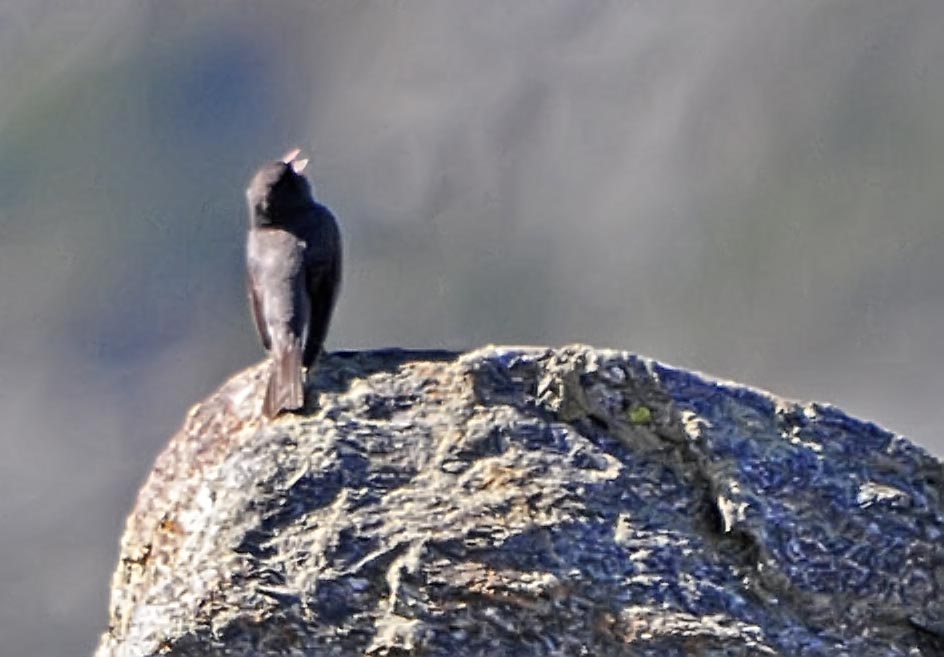
Arriving at the top,  I looked and listened for any birds in this rock-strewn wasteland and indeed heard one. I traced it to a Junco singing from one of the boulders lining the parking lot:


To find a Junco at this level with no tree in sight, just thin patchy low ground vegetation between the rocks, was a surprise. It was the only Junco though and no others responded to his song, nor did we see any other birds, no Ravens or Bald Eagles...

With still no oncoming traffic, driving down was a piece of cake, because of the much broader, long-distance view going downhill.  We made our leisurely way along the scenic Kancamagus Highway home to Brattleboro, VT, glad that we had bought mosquito head nets that kept the black flies out, but frustrating too because it' s near impossible to use them with binoculars.  

Cheers and Happy Birding!


Thanks for stopping by and please leave a comment.


Sunday, April 24, 2011

Spring Migrant Fallout along the CT River

I had been house-bound for a week with a bad bronchitis, just having enough energy to fill the feeders for the new backyard arrivals,  the White-throated Sparrows and Purple Finches, and the still present Juncos and  year around Goldfinches.  But mid week I finally felt well enough for a trip to the trail along the CT River in Hinsdale, NH. It was a blustery day with white caps on the river and fallen leaves swirling through the air. This had not however kept the spring migrants from moving in.  A mixed flock of Yellow-rumped Warblers (Myrtle subspecies) and Palm Warblers (Yellow Eastern subspecies) was foraging in the gravel potholes on the path. Most birds were keeping low to the ground, rising only at the approach of my car.


Along the path Ruby-crowned Kinglets were singing and flitting through the dense brush.


Today, Easter morning,  the sun was out as were my fellow birders with their binoculars and cameras. Yellow-rumped Warblers, and Palm Warblers, swooping Tree Sparrows and Barn Sparrows put on a joyful show. After a long winter it was a day to celebrate the renewal of life. 

Good Birding!