Thursday, June 9, 2011

Gray-cheeked Thrush NOT - Revised

Revision: I should have said to my self, "Calm down, calm down; don't rush to judgement ..." Well the judgement is in: it's a Hermit Thrush. I made the id by going back to same location, found the same bird calling insistently, although this time I did not get a good look at it - too much shade and too fleeting - and compared the call to the Hermit's. Bingo! :-(

Well, I still had two experts agreeing with me that it looked like GCT, so I am not quite red-faced. But I had retract my sighting on eBird and send out corrections.

Original: There is one thrush that looks exactly like the Bicknell's Thrush pictured in my last post.  According to my reading they can only be told apart by voice.. Well, this morning I walked along a path skirting a marshy pond on one side and a mature deciduous forest on the other side. I heard a bird calling close by. At first I thought it was a Veery but the call was much less musical. The bird was perched on  a tree branch about 10 ft off the ground.


The bird;s call sounded like the call of the Gray-cheeked Thrush in Sibley's on my iPod. Yet it would be very unusual to find one in Brattleboro, but it's also hard to imagine it could be anything else. I would appreciate any comments.


Wednesday, June 8, 2011

Bicknell's Thrush - a most threatened species

A once in life-time experience: Yesterday I joined a group of birders on a van tour up  Mt. Washington, the highest mountain in New Hampshire, to see Bicknell's Thrush. We left at 5:30 in the morning and stopped midway at about 3000 ft where the landscape turned into a stunted forest of mostly balsam fir with lesser amounts of spruce, white birch and mountain ash.


We scanned the tree tops and after a while found a BT on a distant tree bathing in the morning sun - too far for the lens on my camera.


We then heard two males chasing each other a short distance down hill from us. Suddenly one of them appeared in a tree very close to us. He wasn't shy at all.


He began singing, asserting that this territory was his.


Because of its fragmented breeding range in remote inhospitable forests at high elevations in the Northeast it is one of the least known bird species in North America. It also one of the rarest and possibly most threatened.

Distribution of Bicknell’s Thrush (BNA)


There may not be more than 50,000 individuals. Its winter range is even more restricted ; it regularly only occurs on four islands in the Greater Antilles where its habitat is threatened by deforestation.


Reference: Birds of North America Online  and Jeffrey Wells' Birders Conservation Handbook

Thanks for visiting. Please leave a comment.


Wednesday, June 1, 2011

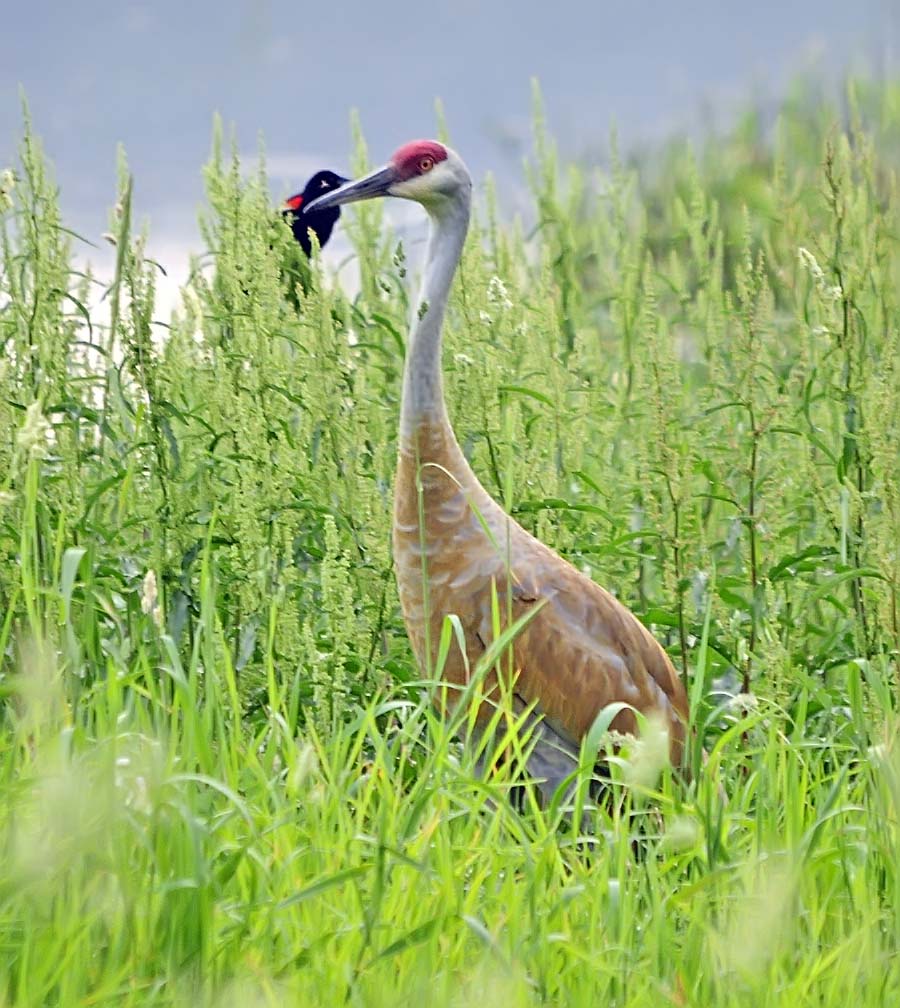
A Pair of Sandhill Cranes

Sandhill Cranes put in a very spotty appearance here in Vermont, and so I was excited to read of  two cranes having been sighted just a few miles from where I live. I got there early this morning and had no trouble locating them foraging near the road around a large puddle in a field as they were slowly making their way from the muddy back edge to the vegetation in front.  I got out and used my car as a blind.


About the rusty discoloration of their plumage I found this in Birds of North America Online:
"Plumage becomes colored adventitiously from water, vegetation, and mud; additionally, Sandhill Cranes intentionally rub their plumage with soil, all of which causes variations in the plumage color ranging from drab-clay to cinnamon-rufous. Stained feathers occur anywhere below the mid-neck but are particularly apparent among the primary and secondary wing coverts and upper breast feathers." Authors Tacha, T. C., S. A. Nesbitt, and P. A. Voh


One showed darker discoloration than the other.

Sandhill Cranes are long-lived - up to 20 year - are monogamous, and stay together as a pair.


One of them ventured too close to a Red-winged Blackbird's nest and had to fend off an attack.


Stretching of wings but not taking off - just yet. I thought I had taken enough pics and had sat back down in the car, thus missing the dramatic end to the show as the pair took off, their clamor filling the the air with hoarse honking and loud swooshing of wings. They flew low and settled again at the far end of the field, well out of my lens' range.


Happy Birding! Please leave a comment.