

America's Most Wanted

Iceland's Most Wanted
But I am being sidetracked. I wanted to talk about a SVAS guided walk with Marlboro College biologist Bob Engel a couple of days ago on the beautiful trails of Hogback Mountain, a defunct ski resort which closed in 1989 and has gradually been reverting back to wilderness.

Overgrown Ski Trail
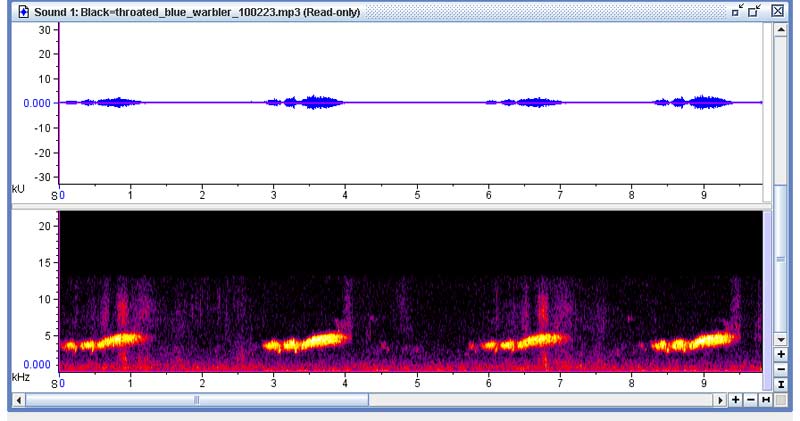
The air was filled with bird songs, but we only caught brief glimpses of the warblers darting through the dense foliage as they gleaned small critters from the leaves and bark. Species included Ovenbird, Yellow-rumped Warbler, Chestnut-sided Warbler, Blackburnian Warbler, Black-throated Blue Warbler... . I was able to record a couple of songs:
Black-throated Blue Warbler song and Spectrogram:
And here, the Ovenbird's emphatic "Teacher Teacher Teacher" song
I confess, this walk showed me up as a complete newbie in bird song identification. There is so much to learn! I am finding out my ears are not very good at picking up the warblers' high-pitched buzzy sounds.
Bob Engel is a gifted guide and teacher with a vast fund of knowledge. During our walk he commented on the polygynous nature of male Red-winged Blackbirds, on why scat deposited prominently on a rock, was probably left there by a Gray Fox, and on many other subjects prompted by what we encountered. He pointed out a small, rather drab looking plant which upon a closer look turned out to be a Horsetail (Exquisetum), one of the most ancient plants going back to the age of dinosaurs and predating the appearance of grasses as ground cover and understory plant. It has a world-wide distribution. I remember playing with a plant like that as a child, pulling sections apart and sliding them back together.
He pointed out the most invasive species in the Northeast, the Japanese Knotweed, which was forming a dense thicket at the edge of a field, sending out satellite colonies far into the field by deep rhizomes. Because of its extensive root system herbicides are required for eradication.
We looked at a meadow made more beautiful by dainty yellow Buttercup intermingling with the grasses. But Buttercup, it turns out, is poisonous to livestock. Once it takes posssession of a meadow the grass can no longer be used for hay. Of course Bobolinks, threatened by habitat loss, building their nests in high grass, benefit from fields being left uncut.
Bob Engel is a gifted guide and teacher with a vast fund of knowledge. During our walk he commented on the polygynous nature of male Red-winged Blackbirds, on why scat deposited prominently on a rock, was probably left there by a Gray Fox, and on many other subjects prompted by what we encountered. He pointed out a small, rather drab looking plant which upon a closer look turned out to be a Horsetail (Exquisetum), one of the most ancient plants going back to the age of dinosaurs and predating the appearance of grasses as ground cover and understory plant. It has a world-wide distribution. I remember playing with a plant like that as a child, pulling sections apart and sliding them back together.
He pointed out the most invasive species in the Northeast, the Japanese Knotweed, which was forming a dense thicket at the edge of a field, sending out satellite colonies far into the field by deep rhizomes. Because of its extensive root system herbicides are required for eradication.
We looked at a meadow made more beautiful by dainty yellow Buttercup intermingling with the grasses. But Buttercup, it turns out, is poisonous to livestock. Once it takes posssession of a meadow the grass can no longer be used for hay. Of course Bobolinks, threatened by habitat loss, building their nests in high grass, benefit from fields being left uncut.

Vermont is beautiful any time of the year, but it is truly glorious in June.

