Showing posts with label Ovenbird. Show all posts

Wednesday, August 10, 2011

Strange Tale of Dog and Deer


This is a true story:
A couple of days ago I was walking along a logging trail on a nearby mountain with my dog Chance. After a sweaty and buggy uphill climb we finally reached the top, a large clearing overgrown with weeds, brambles and small trees. As I was scanning the leaves for small disturbances indicating a bird, Chance took off into the woods. After a few minutes I heard a distant yelp. Fear or pain? I called him back with no response. I heard nothing further. While waiting for him to return I noticed two small birds in the undergrowth nearby, two foraging Ovenbirds who paid little attention to me.


Suddenly, to my relief, I saw Chance trotting through the thinning forest about 50 yards off on my right. With his white coat and large black patches he was easy to spot. As he approached the clearing I expected him to turn toward me, but instead he continued straight on.

I should say a few words about Chance: He is friendly to all creatures except small furry things. Having been bitten as a puppy by an older dog, he is timid with other dogs and, if we encounter any on our walks, he clamps his tail between his legs until they have proven to be friendly. He has not met up with larger animals such as cows or horses. He has never seen deer at close range, only at a distance running across the field next to our house.
What happened next keeps replaying in my mind as if on a stage: a few steps behind him an adult antlerless deer was keeping pace with him. Chance continued to make his slow way through the weeds and low brush, stopping  at times to sniff  or examine something. The deer too stopped moving and resumed his pursuit as Chance moved on. Chance, seemingly unaware to his strange escort, did not once turn around. Soon both disappeared into the woods at the opposite edge of the clearing.

A couple of minutes later I saw the deer again, standing, as if posing, straight ahead at the edge of the plateau framed by two trees with  the sky as a backdrop. After a minute or so the deer walked off, stage left, and Chance reappeared from the woods on my right. Did he circle around behind me?

I had had a clear view of the entire strange spectacle but was so mesmerized by it that it never occurred to me to lift up my camera and and take a picture. So nothing to document it. I am still totally perplexed, still can't make any sense of it. 

A unedited preview of the peacable kingdom?


Jan Bruegel "Paradise" ca. 1620

Thanks for stopping by. Please leave a comment.


Wednesday, June 29, 2011

Does singing make birds feel happy?

Yesterday afternoon after the rain stopped I went for a walk in the woods. Along the path I was surrounded by the Ovenbird's emphatic "teacher, teacher, teacher". This was late into the breeding season when most of the other warblers were quietly foraging for food for their offspring.

Birds do look happy when they sing.


We know that birds live on a very tight energy budget. No wasted motions. Everything has to have a purpose for furthering survival and procreation, and  this holds true for emotions also. We sense a bird's anxiety when a predator approaches a nest or the anger when for example the Robin in my backyard  keeps chasing a Blue Jay through the trees away from her nest. But a feeling of happiness? Is it a luxury? Or a reward for a  behavior that serves a purpose in promoting survival?  Birds sing to attract mates or defend their territory.  But does the act of singing cause the bird to feel pleasure, or put in another way, does it make the bird feel happy?


Several years ago I observed a Mockingbird perched on a tall post singing his heart out. While singing he would  jump up, flap his wings and rise up several feet, drop back down, and do so again and again - a picture of pure exuberance!  He seemed to be jumping for joy - so much happiness! That this was part of part of the male's courtship display did not diminish it.

I unearthed an interesting study addressing the question of happiness. Any pleasurable action in animals, mammals as well as birds, is associated with a release of dopamine in the brain. A study of Zebra Finches has shown that singing increases dopamine release, but only while courting a female. Undirected singing does not.  So a male bird  that sings incessantly to keep out competing males is probably more likely to have an elevated level of the cortisol, not dopamine, and feels stress rather than pleasure.


Happy Birding!


Thanks for visiting. Please leave a comment.

Monday, June 14, 2010

Garden of Eden


People hunger for nature. This is shown in a hilarious yet thought-provoking study undertaken by two Russian artists, Komar and Melamid, who polled people in various countries all over the world to find out what type of painting they would most like to hang on their walls. They set about constructing schematic paintings based on these polls. In their book "Painting by Numbers, a Scientific Guide to Art" page after page shows groups of people in bucolic scenes with lakes, blue mountains, trees, and animals. Their Garden of Eden. Two examples:

America's Most Wanted

Iceland's Most Wanted

But I am being sidetracked.  I wanted to talk about a SVAS guided walk with Marlboro College biologist Bob Engel a couple of days ago on the beautiful trails of Hogback Mountain, a defunct ski resort which closed in 1989 and  has gradually been reverting back to wilderness.

Overgrown Ski Trail

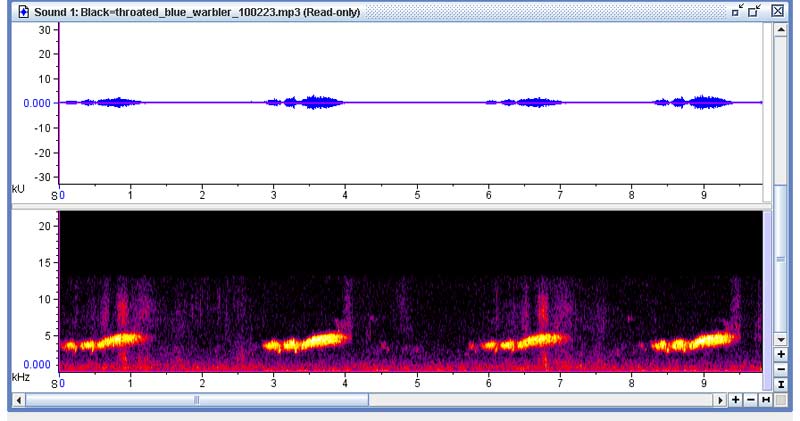
The air was filled with bird songs, but we only caught brief glimpses of the  warblers darting through the dense foliage as they gleaned small critters from the leaves and bark.  Species included  Ovenbird, Yellow-rumped Warbler, Chestnut-sided Warbler, Blackburnian Warbler, Black-throated Blue Warbler... .  I was able to record a couple of songs:

Black-throated Blue Warbler song and Spectrogram:


And here, the Ovenbird's emphatic "Teacher Teacher Teacher" song


I confess, this walk showed me up as a complete newbie in bird song identification. There is so much to learn! I am finding out  my ears are not very good at picking up the warblers' high-pitched buzzy sounds.

Bob Engel is a gifted guide and teacher with a vast fund of knowledge. During our walk he commented on the polygynous nature of male Red-winged Blackbirds, on why scat deposited prominently on a rock, was probably left there by a Gray Fox, and on many other subjects prompted by what we encountered. He pointed out a small, rather drab looking plant which upon a closer look turned out to be a Horsetail (Exquisetum), one of the most ancient plants going back to the age of dinosaurs and  predating the appearance of grasses as ground cover and understory plant. It has a world-wide distribution. I remember playing with a plant like that as a child, pulling sections apart and sliding them back together.

He pointed out the most invasive species in the Northeast, the Japanese Knotweed,  which was forming a dense thicket at the edge of a field, sending out satellite colonies far into the field by deep rhizomes. Because of its extensive root system herbicides are required for eradication.

We looked at a meadow made more beautiful by dainty yellow Buttercup intermingling with the grasses. But Buttercup, it turns out, is poisonous to livestock. Once it takes posssession of a meadow the grass can no longer be used for hay. Of course Bobolinks, threatened by habitat loss, building their nests in high grass, benefit from fields being left uncut.  


Vermont is beautiful any time of the year, but it is truly glorious in June.